Leopold Aschenbrenner is famous in AI circles.
He’s the young former OpenAI researcher who wrote the widely circulated “Situational Awareness” essay about where artificial intelligence may be headed.
He has become one of the more recognizable voices in the world of AGI, superintelligence, compute buildouts, chip demand, and the massive infrastructure boom that may be coming.
So naturally, when his fund, Situational Awareness LP, filed its latest 13F, I was curious.
And what I saw was fascinating.
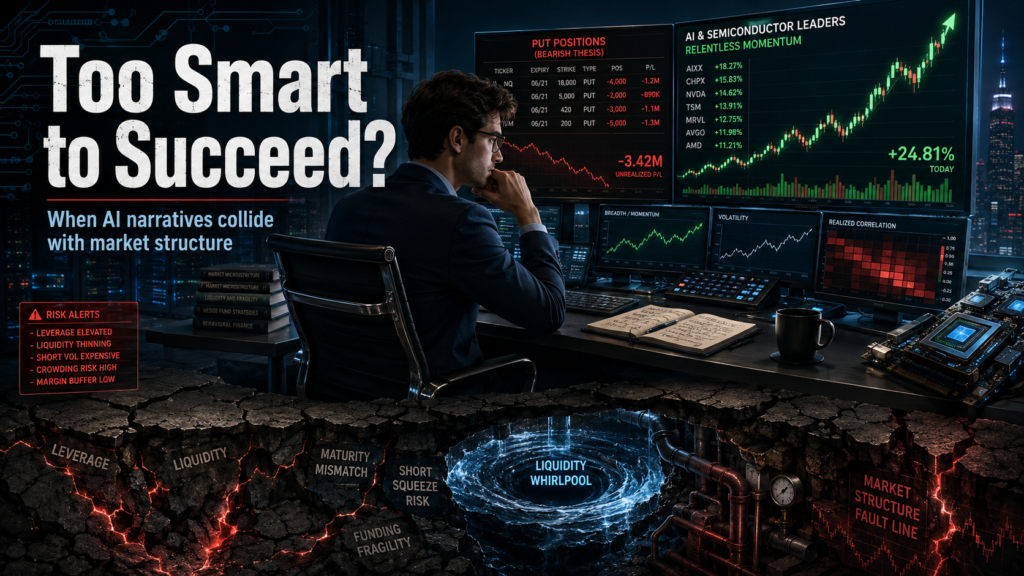
As of the March 31 snapshot, the fund showed large put positions tied to several major AI and semiconductor names, including the VanEck Semiconductor ETF, Nvidia, AMD, Intel, Broadcom, Oracle, ASML, Micron, and Taiwan Semiconductor.
Now, to be fair, a 13F is delayed.
We do not know what they did after March 31. We don’t know whether those puts were outright bearish bets, hedges, spreads, or part of some much larger book that is not obvious from the filing.
But if that snapshot still reflected their real exposure when the chip trend exploded higher, then it may become one of the great modern examples of a problem I’ve seen again and again in the market.
Some investors are not too big to fail.
They are too smart to succeed.
That sounds harsh, but I mean something very specific.
There is a type of brilliant investor who can build a dazzling intellectual model of the world.
They can explain AI, energy demand, geopolitics, chip supply chains, compute clusters, valuation risk, and the future of civilization better than almost anyone alive.
But then they walk into the market and forget that the market is not another dissertation.
It is a machine.
And that machine has plumbing.
It has leverage, forced buyers, forced sellers, short squeezes, dealer hedging, liquidity vacuums, ETF flows, margin calls, borrow pressure, option positioning, and all kinds of hidden structure boiling underneath the visible story.
That is where a lot of very smart people get hurt.
They live in the model.
The market lives in the order book.
And sometimes the order book wins.
That is why the name Situational Awareness is almost too perfect.
Because you can have tremendous awareness of the AI situation…
And still miss the trading situation.
You can understand the compute buildout, the chip bottlenecks, the power demand, and the national security stakes.
But if you are standing in front of a runaway trend with the wrong structure underneath you, the market does not stop and say, “Wait, this guy is very impressive.”
It just runs you over.
We have seen this movie before.
Long-Term Capital Management had Nobel Prize winners, brilliant models, enormous credibility, and trades that looked hedged on paper. But when liquidity disappeared, the relationships they were counting on stopped behaving normally.
The math did not save them.
The structure broke them.
GameStop was another lesson.
You could have said the stock was overvalued, irrational, ridiculous, detached from reality, and impossible to justify fundamentally.
And you would have been right about a lot of that.
But if you ignored the short interest, the borrow pressure, the forced covering, and the crowd piling into the squeeze, you missed the real trade.
The story was not “GameStop is a great business.”
The story was, “Too many people are trapped on the wrong side of the same door.”
Melvin Capital blew up and had to be bailed out by Ken Griffin (the real head of Robinhood).
That is market structure.
Archegos was another one.
Bill Hwang’s private fund did not simply lose money because a few stocks went down. It blew apart because of leverage, swaps, concentrated positions, margin calls, and prime brokers suddenly realizing they were all exposed to the same hidden whale.
Once the selling started, the fundamentals became secondary.
The liquidation became the story.
That is how markets really break.
And it is also how markets can rip higher for reasons that have very little to do with what “should” happen.
Sometimes shorts get trapped.
Sometimes liquidity vanishes.
Sometimes dealers have to chase.
Sometimes ETFs create strange flows.
Sometimes natural sellers disappear.
Sometimes everyone waits for a pullback that never comes, and the absence of sellers becomes its own kind of fuel.
This is why I do not trust stories by themselves.
I do not care how intelligent the story sounds. I do not care how famous the person is. I do not care how clean the thesis looks in a PDF, podcast, interview, or 165-page manifesto.
The market does not pay for brilliance.
It pays for being on the right side of price, structure, and evidence.
That lesson cost me three blown trading accounts.
Back then, I thought I could reason my way through the market. I followed gurus, chart patterns, indicators, news, opinions, and all the usual tools traders are handed when they first get started.
Eventually, I realized something painful.
My opinions were not enough.
My logic was not enough.
My ability to explain the market after the fact was not enough.
I needed proof.
I needed rules.
I needed backtests.
I needed to know what had actually worked across real market history, not what sounded smart in my own head.
That is the philosophy behind Portfolio Boss.
We do not try to win by being clever.
We try to win by testing.
We build strategies, test them, filter them, combine them, and look for evidence before risking capital on a story.
Because the market has a special talent for humiliating people who are sure they are the smartest person in the room.
And sometimes, the danger is not that someone is too dumb to see what is happening.
The danger is that they are too smart to succeed.
They have a theory for everything…
Except the thing actually moving the market.
That is why I think this Situational Awareness filing is so interesting.
Maybe they adjusted perfectly, or maybe the puts were hedges.
Maybe the filing only shows one visible corner of a much bigger trade.
But the broader lesson is too important to ignore:
Being right about AI does not automatically make you right about AI stocks.
Being right about the future does not automatically make you right about the trade.
And being aware of the big situation does not mean you understand the hidden structure underneath the market.
That is where most traders get blindsided.
That is where smart money sometimes becomes trapped money.
And that is exactly why we test.
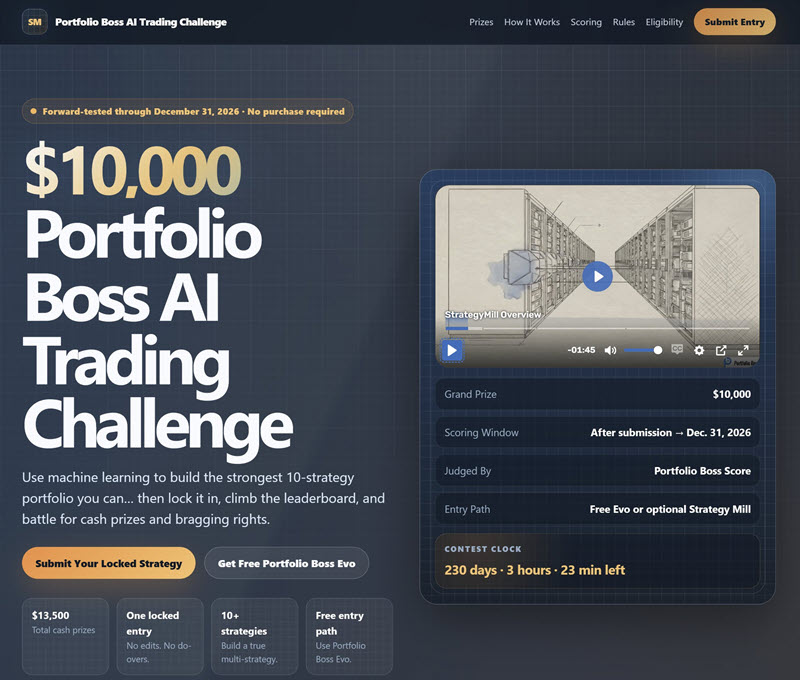
P.S. Speaking of testing, here’s what’s coming soon. Think you have what it takes to make it to the top of the leaderboard? Just building out the infrastructure, then we’ll launch soon:



Responses