There’s a dangerous mistake traders make because it feels so intelligent.
They look at the market and start building a case. The yield curve is inverted. Breadth is weak. Valuations are high. Sentiment is stretched. New highs are fading. Economic data is slowing.
Maybe a scary chart pattern shows up too.
Then they step back and say, “Look at all this evidence. The market has to fall.”
That sounds careful. It sounds sophisticated. It sounds like Sherlock Holmes connecting clues.
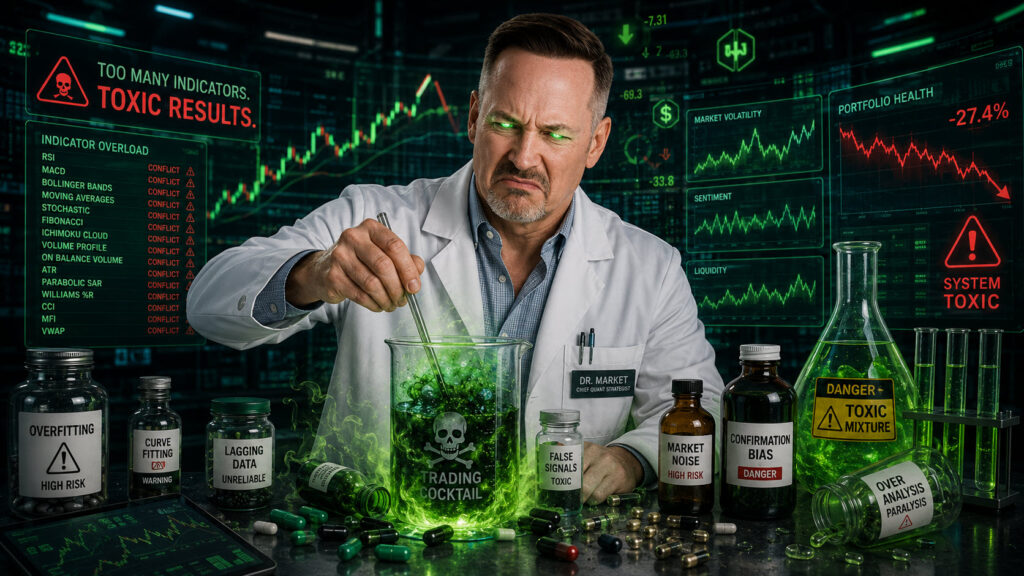
But in many cases, it’s more like a trader playing doctor with an untested drug cocktail.
Imagine a doctor saying, “This blood thinner works. This painkiller works. This sleep medication works. This blood pressure drug works. And this supplement works.”
Then he pours them all into one bottle, hands it to you, and says, “Each ingredient has evidence behind it… so the combination must be even better.”
You’d run out of the office.
Because everybody understands that medicine doesn’t work that way. A drug can be useful by itself and dangerous when mixed with something else. Two safe ingredients can become poison when combined.
Trading signals work the same way.
An inverted yield curve may matter by itself. Weak breadth may matter by itself. Valuation may matter by itself. Sentiment may matter by itself.
But that does not prove the cocktail works.
Once you combine those signals, you’ve created something new. And that new thing needs its own evidence.
There’s even a scientific name for part of this mistake: the conjunction fallacy. It’s the human tendency to think a more detailed story is more likely, even though every added condition can only make the exact setup less common.
Tversky and Kahneman famously showed this in probability research, and the same mistake shows up constantly in market analysis.
Here’s what that looks like in trading.
Maybe you start with 1,000 examples of the market making a new high.
Then you add an inverted yield curve.
Now maybe you have 100 examples.
Then you add weak breadth.
Now maybe you have 30.
Then you add stretched sentiment.
Now maybe you have 12.
Then you add a chart pattern.
Now maybe you have 4.
Then you add one more “important” signal.
Now maybe you have 1.
You thought you were standing on a mountain of evidence. But after stacking all those conditions together, you may be standing on a single grain of sand.
That’s the trap.
Your brain says, “More reasons means more certainty.”
But in the market, more reasons can mean fewer examples, weaker evidence, and a much higher chance you’re fooling yourself.
This is why smart traders can still lose money while sounding incredibly convincing. They are not really testing the market. They are collecting reasons.
And collecting reasons is not the same thing as having evidence.
A trader will say, “Inverted yield curves are bearish.”
Fine.
“Bad breadth is bearish.”
Fine.
“Valuation is too high.”
Fine.
“But when all these things happen together, the market must crash.”
No.
That final leap is where the damage happens.
You cannot test the ingredients separately and pretend you tested the cocktail. The exact combination has to be tested together, with enough examples, out of sample, after costs, and with the rules frozen before the test.
Otherwise, it is not evidence.
It is a guess wearing a lab coat.
And guesses wearing lab coats are some of the most expensive things in trading.
That’s why we built Portfolio Boss around tested rules instead of market storytelling. We don’t want Frankenstein trades stitched together from headlines, indicators, economic theories, and gut feelings.
We want to know what actually happened before. How many times it happened. Whether it survived out of sample. Whether it still worked after costs. And whether the rule kept working after it was frozen.
Because the market does not reward the trader with the most reasons.
It rewards the trader with the best-tested evidence.
So the next time someone stacks together seven scary indicators and calls it “analysis,” ask one simple question:
Was that exact cocktail tested?
If not, they don’t know what it does.
They’re just mixing bottles and hoping it isn’t poison.
P.S. This is why my June 5th prediction is different. I’m not stacking random indicators and pretending the story sounds good. I’m looking at structural changes, market behavior, and historical evidence that can actually be studied.
Watch the video now and see why June 5th could be one of the most important market dates of the year.



Responses