
Forecast Friday: The Only 20 Stocks Still Trending

Corona Del Mar, CA
Howdy Friend!
The flurry of warnings we gave about tech are playing out.
Those promising recoveries started failing. Stocks that were supposed to lead the next leg higher couldn’t hold their trends. Meanwhile, people were getting enthusiastic about buying right where our strategies like to sell.
Then came Thursday’s selling, the nervous phone calls, and the text messages.
I got some of those myself.
But while traders were panicking, we were getting buy signals.
Our QQQ strategy sold the rally. Now it wants a discount
The built-in QQQ strategy in Portfolio Boss Evo sold at a very good price during Wednesday’s post-election rally.
Then the market fell apart.
Now that same strategy is set to place a limit order to buy QQQ back at a discount.
Sell into enthusiasm. Bid lower when enthusiasm becomes panic.
Most of you reading this already have access to Portfolio Boss Evo, so you can open the strategy and inspect the rules yourself. They’re right there.
You can see what triggers a trade, how it exits, and how it performed historically.
That’s a whole lot more useful than tea leaves, a crystal ball, or shaking a Magic 8 Ball until it finally says something encouraging.
A semiconductor bust can coexist with an attractive broader market
This is the big picture I don’t want you to miss.
I believe we’ve seen a major bubble and bust in parts of the semiconductor and AI infrastructure trade, particularly the more commodity-like memory and storage businesses.
Look at Western Digital, the hard-drive manufacturer. It rocket from fifty bucks to $800, then lost more than half its value.
Give me a break. That’s the sort of price behavior that gets my attention when I’m looking for a bubble.
Here’s a prediction: It’ll be dead money for ten years.
Pull up semiconductor charts from 1999 and 2000. Look at the excitement, the spectacular advances, and what followed.
A real technological revolution can still produce a financial disaster for people who pay too much, borrow too much, or refuse to leave when the trend ends.
The technology attracts investment. Investment becomes over-investment. Leverage magnifies the excitement, then magnifies the damage.
And in commodity-like businesses, all that investment can eventually create additional capacity and tremendous pricing pressure.
My concern is that investors have priced some of these businesses as though unusually favorable conditions will last indefinitely.
They usually don’t.
But the major indexes still look reasonably good to me, and some of our other S&P 500 strategies remain on buy signals. They haven’t triggered their exits.
So I’m still finding the broader market attractive, even while parts of the old leadership look like a demolition site. KABOOM!
Money is rotating. We need to follow the opportunity as it moves.
These are the 20 stocks still passing my trend scan
Here are the 20 names currently qualifying in my Nasdaq 100 trend scan:
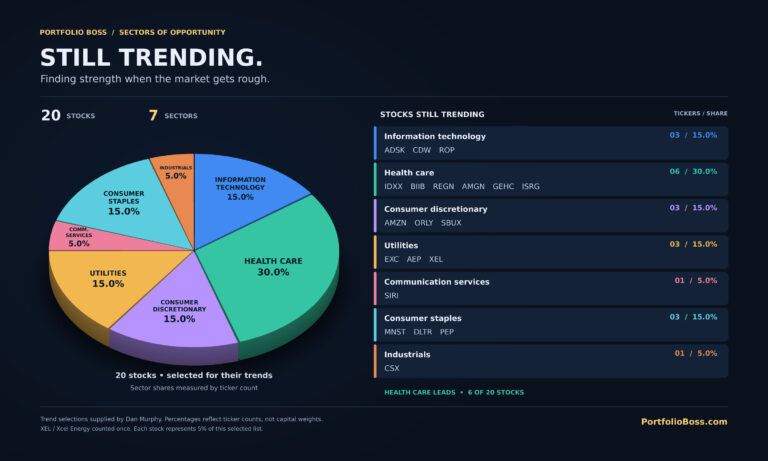
Health care accounts for six of them, or 30% of the list: IDEXX, Biogen, Regeneron, Amgen, GE HealthCare, and Intuitive Surgical.
That’s where I’ve been pointing since early October. We covered the shift toward biotech and health care in the October 16 Forecast Friday video.
The opportunity moved. It’s still there.
If you aren’t interested in making quick trades through violent swings, these surviving trends deserve your attention.
As for crypto, I’m still not interested right now.
The warning signs started long before Thursday
Back in May, I started talking about signs of a bubble.
Leopold Aschenbrenner was one example. A very bright young man, suddenly elevated to something approaching financial prophet.
I wrote “Too Smart to Succeed” because intelligence and market wisdom are two different things. Knowing a great deal about AI doesn’t tell you how much leverage your portfolio can survive.
Then we had the move to eliminate the $25,000 pattern day trader requirement, the return of single-stock futures, and enormous IPOs competing for investors’ money.
SpaceX alone raised $75 billion.
A buddy told me he got more SpaceX shares for his IPO allotment than he expected. That set off my alarm bells.
When Wall Street suddenly has plenty of something exciting to sell you, I start wondering why everyone is being so generous.
None of those things gives us a magic date for a market top. Together, though, they looked awfully familiar.
More enthusiasm. More ways to speculate. More stock for the public to absorb.
Wall Street doesn’t generally schedule its big share sales around getting you a bargain.
A high IQ won’t rescue an overleveraged portfolio
Just after the Fourth of July holiday, we started seeing sell signals across the board as chip-stock momentum deteriorated.
Later that month, Aschenbrenner’s portfolio lost 67%, and Ken Griffin’s Citadel bought the bulk of its stock positions in a rescue transaction.
The position sizes had already done the damage.
Markets eventually pushed higher again, giving us another version of the same lesson.
When we entered Claude into our $10,000 AI trading challenge, it initially looked like a genius.
It climbed about 18%, then gave back all of that gain and considerably more.
An electronic Leopold, complete with beautifully articulated reasons for losing money.
Great companies. Strong demand. An enormous technological future.
The dangerous assumption was that the stocks should keep behaving until earnings and revenue gave everyone permission to worry.
Stocks don’t wait for bad earnings to arrive before falling.
Prices can anticipate changing expectations months ahead of the reported numbers. By the time the earnings report explains the decline, your account may have already experienced the entire presentation.
Recently, we saw another round of tech trends try to restart.
Then they failed.
That’s why I started warning again.
The comfortable place to buy can be the expensive place to learn
A stock makes a new high, and people say it’s too expensive.
It plunges to a new low, and they say it’s too dangerous.
But let it drift into the middle, draw a reassuring Fibonacci line across it, and suddenly everybody feels like a professional.
Our tests have repeatedly found opportunities doing the opposite of that familiar retracement logic:
Buying new highs under the right trend conditions. Buying new lows under the right mean-reversion conditions. Selling into the recovery where other people finally feel comfortable buying.
Some trading “knowledge” can be worse than knowing nothing, because it gives you confidence in a rule you’ve never actually tested.
A broken trend can still deliver a good bounce
Take those supposedly catastrophic “support breaks.”
In our historical research, many of those breaks have been followed by roughly a week of recovery. We’ve seen that behavior going back to the early 1980s, when highly leveraged S&P 500 futures entered the picture.
Draw a line, watch price cross it, declare disaster.
Then watch the market rally after you sell.
Thursday’s break produced another batch of buy signals for us in stocks other people were unloading. The upcoming QQQ limit order is another concrete example of looking for opportunity after prices fall.
That doesn’t mean those broken trends have suddenly become healthy.
A stock can offer a worthwhile short-term bounce while remaining a lousy trend trade.
We could see some big swings from here, including sharp upside after the selling exhausts itself.
But don’t spend the next six months chasing a busted bubble down the escalator to the poor house, calling every landing “the bottom.”
A tested mean-reversion trade has entry and exit rules. “It used to be $800” isn’t much of a trading plan.
Before you trust a pattern, make it prove itself
Whenever I explain the anti-Fibonacci idea, somebody wants to tell me their favorite pattern absolutely works.
My response is simple: prove it.
Define the rules. Test them. Include the costs. Show what happens on data you didn’t use to build the strategy.
A convincing screenshot with three arrows doesn’t quite clear that bar.
And I say this somewhat tongue-in-cheek, because these days I don’t even have to program every strategy myself. The computer can build candidates from the building blocks we give it, searching for the characteristics we want.
It has no emotional attachment to Fibonacci, an AI stock, or something it heard on television.
But a computer can still fool you with a beautiful backtest. You can also fool yourself by giving it enough chances to find something beautiful.
That’s why the testing process matters.
We evaluate strategies on out-of-sample data, and we leave an additional entire year sealed off until the final check.
Only after a candidate looks good do we unblind that year and see how it behaved.
That doesn’t make a strategy invincible. It gives us a much better way to challenge the story before putting money behind it.
Why we don’t short individual stocks
I get asked this constantly, especially when I’m pointing out a bubble.
An unhedged short has an ugly asymmetry. The most the stock can fall is 100%. There’s no comparable ceiling on how far it can rise.
Melvin Capital’s experience with GameStop is a memorable reminder of what a crowded short can do to a portfolio.
I’d rather avoid that particular excitement.
We can use inverse ETFs such as SH, PSQ, and DOG when a tested strategy calls for them. They target the opposite of their indexes’ daily returns, so how you trade and hold them matters.
TLT, the long-term bond ETF can also be used, although it’s not quite an inverse of the stock market.
In my testing, the attraction of these defensive strategies often isn’t a spectacular standalone return. It’s how they can work alongside other strategies to make the overall portfolio more consistent.
At this stage of my life, smoother has become a very attractive word.
Let the rules do the worrying
I don’t want to be panicking because everyone else is panicking. I learned that lesson a long time ago.
I want to own strength when the rules favor strength, buy weakness when the rules favor a rebound, and get out when the exit arrives.
Wednesday’s QQQ sale and the upcoming lower buy order illustrate that approach nicely.
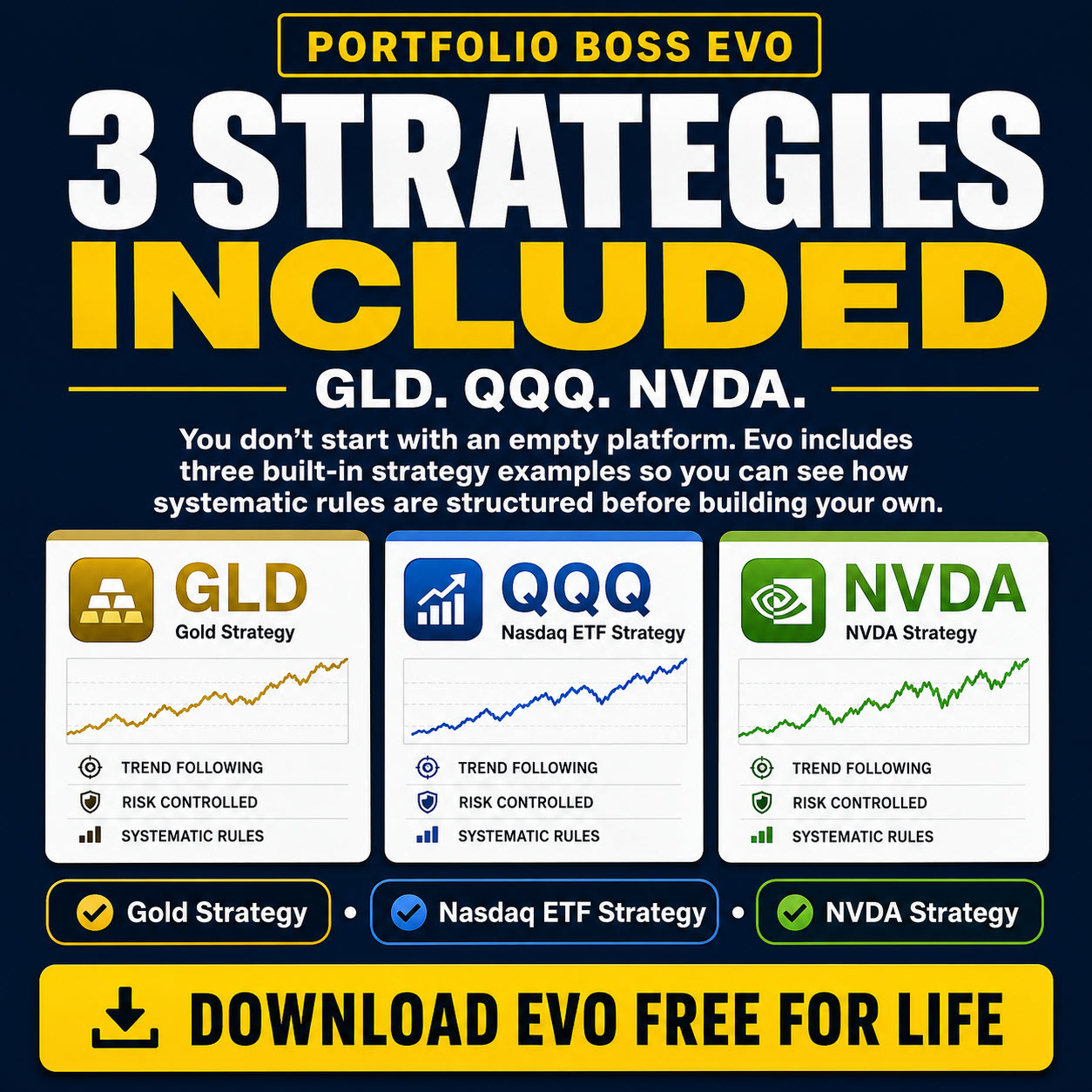
Open Portfolio Boss Evo and take a look at the built-in QQQ strategy. Read the rules.
Then compare that process with staring at a falling stock and asking a Magic 8 Ball whether it’ll come back to breakeven.
I know which one I’d rather trust with my retirement.
P.S. Coming soon: I connected my own account to Interactive Brokers’ AI/MCP integration, and I’ll tell you what I found. I’m also taking a hard look at those prop firms promising to “fund you” and share the profits (Hint: They’re scams).
Plus sharing some of our day-trading research…
Everyone will also get access to APM — Autonomous Portfolio Management — at least for paper trading with Interactive Brokers, so you can see it work yourself.
Meanwhile, we’ve had the newer AI coding models combing through Portfolio Boss around the clock 24/7. The next release has well over 100 bug fixes and new features.
Turns out AI is considerably more useful fixing trading software than explaining why its losing stock picks should be winning.
Trade smart,
Dan “Prince of Proof” Murphy


Responses