
How to Spin an Ugly Stock Chart Into Gold

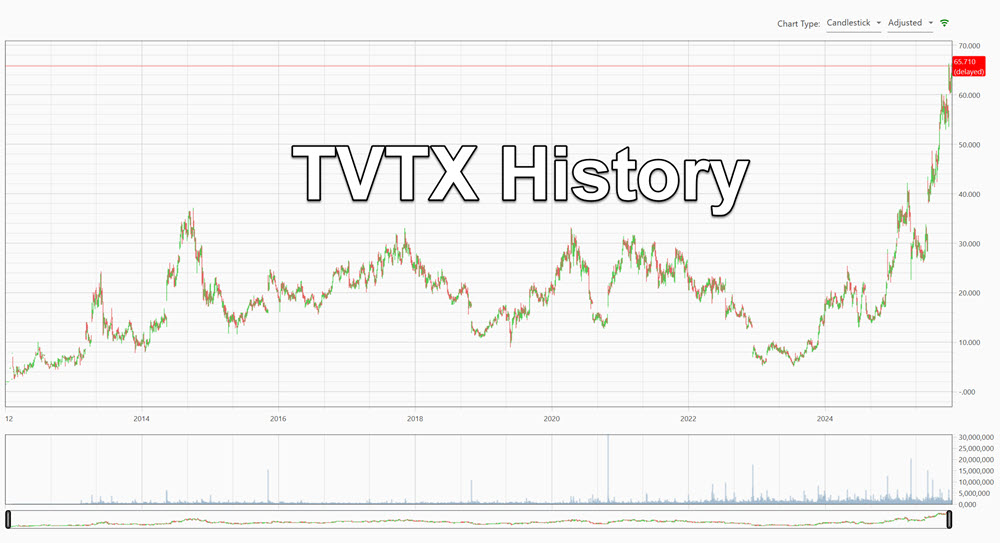
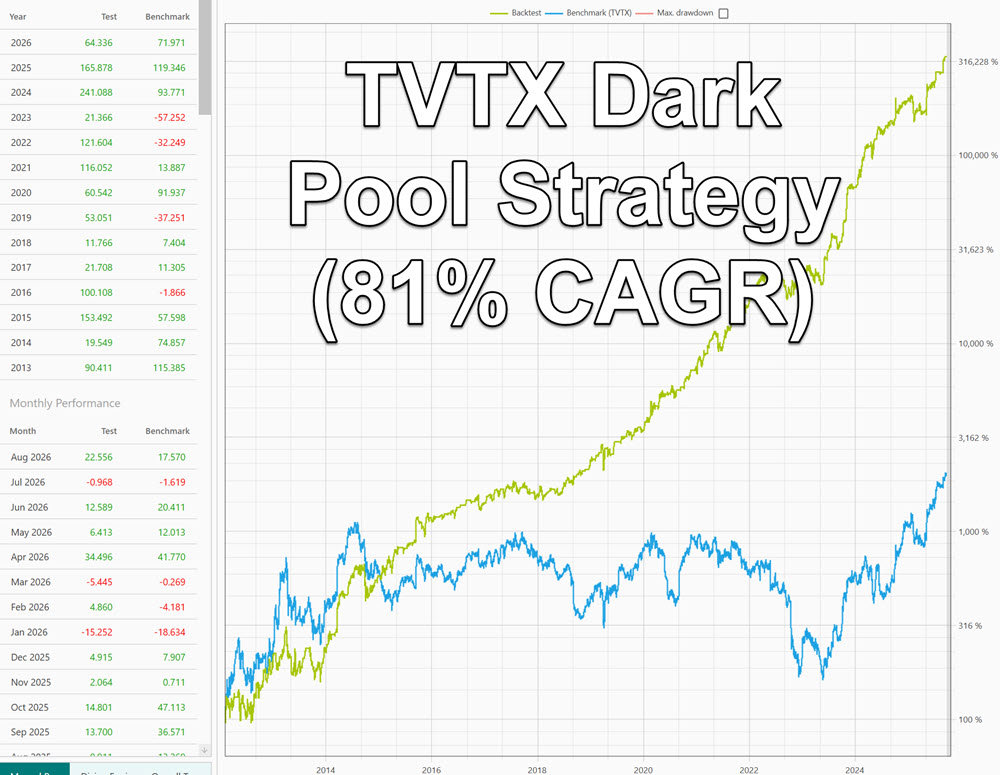
The backtest produced an 81% average annual return with very little drawdown.
To be clear, that’s a backtest — not a promise that TVTX is going to hand you 81% a year from here until they put me in the ground.
What’s fascinating to me is where the return came from.
It wasn’t another moving-average crossover.
It wasn’t a trendline.
It wasn’t because Jupiter entered the seventh level of Fibonacci.
It came from patterns buried inside data connected to off-exchange trading.
And this is becoming a very big part of the market. Off-exchange trading…which includes dark pools, wholesalers and other non-exchange venues…now regularly accounts for around half of U.S. stock trading volume.
According to the SEC, off-exchange volume for Nasdaq-listed stocks had climbed to about 51.9% by January.
There’s a pretty logical reason large traders use these venues. If you’re trying to move a giant position, you generally don’t want to stand on the roof of the NYSE with a bullhorn announcing what you’re about to do to every algorithm on Wall Street.
But here’s where it gets interesting for us.
Some of that activity leaves data behind.
We can study reported short-sale activity and other unusual datasets around off-exchange trading, feed that into the machine learning, and ask a very simple question:
Is there actually a repeatable pattern here?
Not, “Can I tell a good story about it?”
Not, “Does this chart look bullish to me?”
Does it work?
That distinction has become even more important after the slightly insane project I just finished.
I have now completed roughly 1.2 BILLION backtests.
Yes, billion with a B.
I don’t know if there’s a Guinness World Record category for “Guy Most Likely to Need to Go Outside and Touch Grass,” but I probably have a shot.
This became possible because we finally synced our machine-learning research process with Strategy Mill and expanded it across ALL U.S. stocks and ETFs with more than $1 billion in market capitalization.
That $1 billion cutoff matters because I’m interested in things we can actually trade, not some 17-cent mining stock where your $8,000 order accidentally causes a takeover.
And Strategy Mill has completely changed how I do this research.
You can copy and paste hundreds — or even thousands — of symbols into Portfolio Boss, press Start, and walk away. Depending on the size of the job and your computer, you might come back days later or a week later to the survivors.
More importantly, the software filters the results. For example: “Show me only the strategies with more than 40% CAGR, profit factor > 2, and 10+ years of history.”
This is a much bigger deal than it sounds.
Years ago, I used to manually dig through tens of thousands of garbage strategies looking for the handful that deserved further testing.
I still have psychological scar tissue from that.
It’s not ditch digging. Nobody is going to make a documentary about my heroic struggle clicking a mouse in an air-conditioned office.
But after you’ve inspected the 9,732nd useless backtest, your brain begins reacting to the computer screen the same way your hand reacts to a hot stove.
Thankfully, my team has automated huge parts of that process, turning months of work into hours.
And after going through this much data, some things became glaringly obvious.
I found characteristics that keep appearing in the cream-of-the-crop strategies.
I found places where genuine edges seem to cluster.
I found things that look fantastic until you examine them the right way.
And I found several ways a beautiful backtest can still lie to you — even when you’re already doing things such as withholding out-of-sample data.
That last one is extremely important today.
Computers are so fast that it’s incredibly easy to accidentally create something that perfectly explains the past and knows absolutely nothing about the future.
We’ve also had one hell of a bull market since the 2009 bottom. If you aren’t careful, a trading strategy can appear to be a genius when what you’ve actually discovered is:
Stocks went up.
Thank you, Professor.
That’s why the testing methodology matters so much.
And this brings me to something else I’m putting in the report, because I think it’s one of the most useful mental tricks an evidence-based trader can learn.
The human brain LOVES jumping over the annoying part in the middle.
Someone says:
“The Baltic Dry Index is collapsing, therefore a recession is coming.”
Sounds logical.
Or:
“The cost per AI token keeps falling, therefore AI stocks have to fall.”
Also sounds logical.
There’s just one teeny-tiny problem.
Where’s the study?
You started with a hypothesis and somehow arrived at a conclusion without bothering with all that irritating research in between.
It’s the intellectual equivalent of saying, “My neighbor bought a Corvette and six months later got divorced. Therefore Corvettes cause divorce.”
Maybe. Or maybe a midlife crisis triggers both.
So let’s collect a little more data before we notify Chevrolet.
Markets are especially dangerous because an explanation can sound incredibly intelligent and still have no predictive value whatsoever.
I learned this lesson the expensive way.
Over the years I’ve studied Elliott Wave, Gann angles and just about every famous technical-analysis idea you’ve heard of. I spent thousands of hours on some of this stuff, and admitting that I’d wasted that time wasn’t particularly enjoyable.
Especially because I’d occasionally told OTHER PEOPLE how great some of it was before screwing my head on straight.
Oops.
But more than 20 years ago, once I started objectifying these ideas and testing them with computers, I began discovering something uncomfortable: a lot of things that look convincing to the human eye simply fall apart when you force them to obey precise rules and then test those rules on unseen data.
That’s one of the reasons I started I  Evidence-Based Trading in the first place.
Being evidence-based doesn’t mean you have to become some humorless robot who refuses to have an opinion until a double-blind randomized trial arrives from Johns Hopkins.
It means learning to separate a good story from good evidence.
And believe me, Wall Street has a virtually unlimited supply of good stories.
Which is why I’m working furiously to finish the new 1.2 Billion Backtest Report.
I’m about 80% done as I write this, I’ve given myself a deadline, and I’m planning to get it into your hands within the next couple of days.
It’s free.
Consider it a courtesy for putting up with this knucklehead in your inbox.
I’ve been writing newsletters like this for decades now, and I’m happy to say that we’re operating further out on the frontier of computer-aided strategy design than we’ve ever been.
And that brings me to the other gigantic piece of news this week.
Autonomous Portfolio Management is finally here.
APM.
We’ve had some false starts on this project, because what we were building turned out to be dramatically harder than “auto-trading.”
Auto-trading is relatively easy.
A signal appears. Send an order.
Autonomously managing an entire portfolio across strategies, positions, brokerage accounts, mismatches between the strategy and the real account, advanced order types and all the weird things that happen once actual money meets actual markets?
That was a completely different animal.
On my highly scientific Pain-In-The-Ass Meter, this project scored a perfect 10 out of 10.
Maybe 11.
But the current version has now reached the point where I’ve been unable to break it, and this week I’m moving into testing it with real money.
It includes multi-account portfolio management, handles situations where your real brokerage positions don’t perfectly match the strategy, and manages a whole collection of problems that ordinary “auto-trading” systems largely leave to the human.
I haven’t found another retail trading platform doing the full job we’ve built here.
And that fundamentally changes what Portfolio Boss can become — and frankly, how we’re going to structure our offers going forward.
I’ll have a lot more to say about that very soon.
For now, I’m finishing the 1.2 Billion Backtest Report.
When you read it, I only ask you to bring an open mind, because some of the results are going to run directly against things traders have been taught for decades.
I’ve had to swallow that pill myself plenty of times.
That’s the bargain you make when you decide the evidence gets the final vote.
Sometimes your favorite idea wins.
Sometimes the computer looks at it for five minutes and says, “Dan, this is bullshit.”
And although that’s slightly less comforting than Rumpelstiltskin turning straw into gold, it has saved me an enormous amount of time and money over the years.
More from me very soon…

Responses