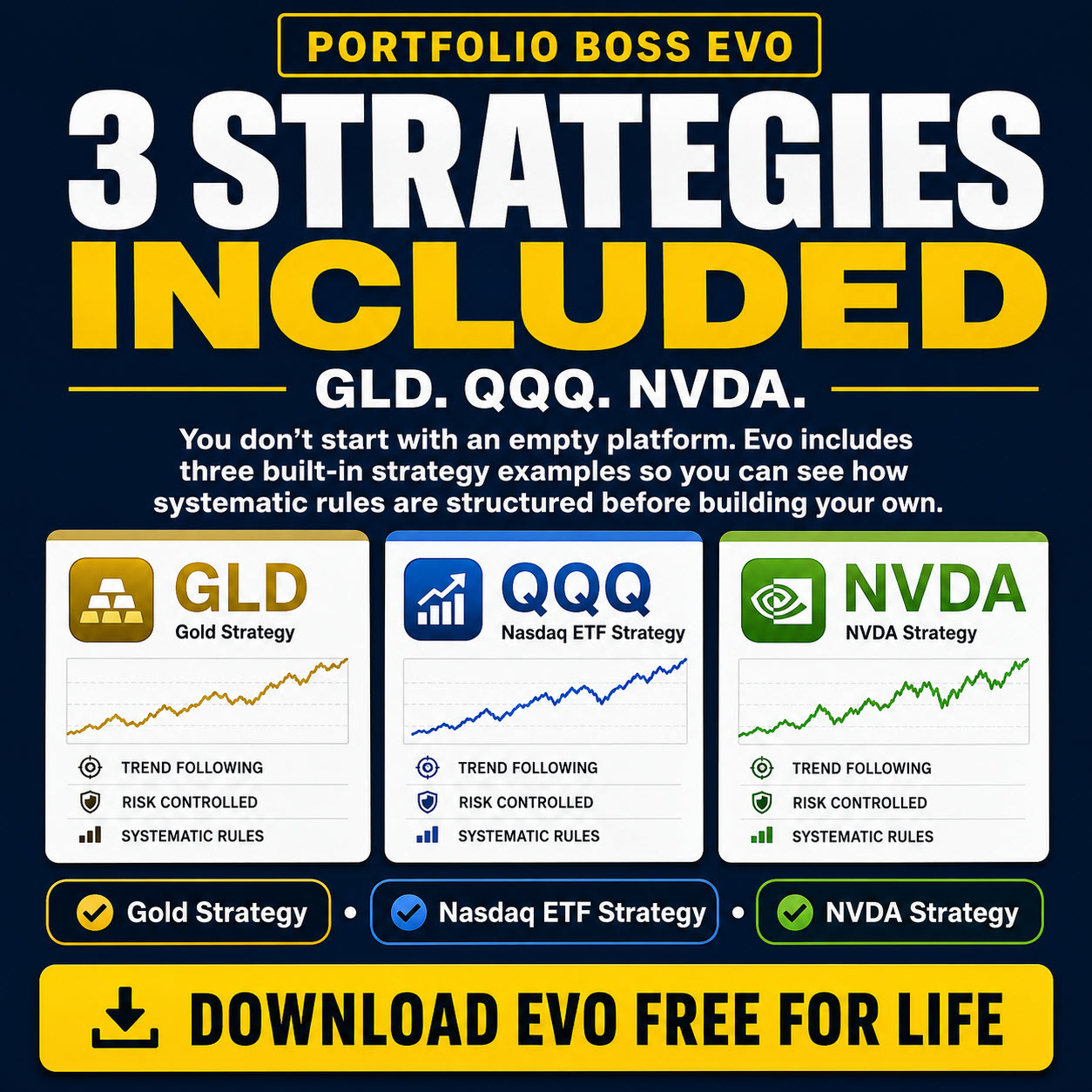
Multi-strategy trading gives different trading methods a job in the same portfolio. Instead of asking one strategy to handle every market, you build a team: one follows trends, another buys pullbacks, and another looks for opportunities in a different market.
What multi-strategy trading means
A multi-strategy portfolio holds several independent, rules-based strategies at the same time. Each strategy decides on its own when to buy and sell. Together they share one account, or a set of accounts, with capital split between them.
The strategies can differ by market (stocks, sector ETFs, bond ETFs), by style (trend following, mean reversion, rotation) or by timeframe. What matters is that they do not all win and lose at the same time.
Why one strategy is rarely enough
- Every strategy has bad stretches. Even a strategy with a strong long-term record can go months without new highs.
- Markets change character. A trend-following system can struggle in a choppy, sideways market, while a mean-reversion system may thrive there.
- Drawdowns test discipline. The deeper and longer a drawdown, the more likely a trader is to abandon the plan right before it recovers.
How combining strategies smooths the ride
When strategies are not closely correlated, their losing periods tend to land at different times. When their returns complement each other, the combined equity curve can be smoother. Check that in the combined backtest: look at the depth and length of the losing stretches, along with the return. A portfolio that’s easier to live with is easier to keep trading.
| Single strategy | Multi-strategy portfolio | |
|---|---|---|
| Dependence | One set of rules carries everything | Several rule sets share the load |
| Drawdowns | Felt in full | Can be cushioned by other strategies |
| Market changes | Can stall when conditions shift | Different strategies suit different conditions |
| Work to manage | Simple | More moving parts, best handled with software |
What makes a good strategy lineup
- Low correlation. Strategies that trade different markets or use different logic add more than near-copies of each other.
- Robust testing. Evaluate each strategy on periods it wasn’t built on, including different market conditions. Cross-market tests add evidence where the same rules are meant to transfer.
- Clear allocation rules. Decide in advance how capital is split and when the lineup changes.
- Consistent execution. More strategies mean more orders. Automation takes repetitive order entry off your hands and helps you follow the plan consistently.
How to measure diversification between strategies
Diversification is easy to claim and harder to check. The most common measure is correlation: how closely two strategies’ daily or monthly returns move together. Strategies with low or even negative correlation add the most to a portfolio, because they tend to make and lose money at different times. Correlation is not the whole story, though. Two strategies can look uncorrelated in normal markets and still fall together in a crash, so it is worth looking at how each one behaved during the worst periods in your test, not just on average.
A practical check is to line up each strategy’s biggest drawdowns. If they all happened in the same months, the lineup is less diversified than the numbers suggest. If the bad stretches are spread out, the strategies are genuinely sharing the load.
Allocating capital across strategies
Once you have a lineup, you need a rule for splitting money between the strategies. There are three common approaches:
- Equal weight. Each strategy gets the same share of capital. It is simple and avoids betting heavily on any single backtest.
- Risk-based weight. Strategies with bigger swings get smaller allocations, so each one contributes a similar amount of risk.
- Rules-based selection. The lineup itself changes on a schedule, with capital going to the strategies that currently meet defined criteria.
Whatever method you use, decide it before you start trading and write it down. Changing allocations in the middle of a drawdown is one of the most common ways traders undo the benefits of diversification.
Common mistakes with multi-strategy portfolios
- Too many near-copies. Ten versions of the same trend-following idea on similar stocks behave like one strategy with extra trading costs.
- Judging each strategy alone. A strategy that looks mediocre by itself can still improve the portfolio if it does well when the others struggle.
- Ignoring market conditions. Some strategies thrive in trends and others in choppy markets. Regime switching rules can help, but a lineup built for several conditions is often the more robust answer.
- Overfitting the combination. It is possible to curve-fit a portfolio of strategies just as easily as a single strategy. Test the combined portfolio on long histories and unseen periods.
Let software handle the extra moving parts
More strategies create more signals and orders. This is exactly the sort of repetitive work a computer should do for you. Define how the portfolio operates, then use software to track the positions and prepare the trades. Spend your attention reviewing the plan and its behavior, rather than copying orders from one screen to another.
Build and manage the lineup with Portfolio Boss
Portfolio Boss was built by trader Dan Murphy, who began trading in 1997. His focus is a practical one: pursue greater consistency while giving clients less daily work.
PB’s machine learning builds trading rules. Strategy Mill builds and filters candidates across large symbol lists, and the multi-strategy tools bring strategies together. Meta ML is like the conductor of an orchestra: each month, it picks which strategies will trade.
Autonomous Portfolio Management (APM) handles trading across multiple Interactive Brokers accounts. Choose full automation, or use Co-Pilot: APM prepares the orders, you review them, and you press Transmit. A portfolio of strategies shouldn’t require a portfolio of daily chores.
Put your next idea to the test, free
Build your first strategy, then explore how it could fit alongside others. Portfolio Boss Evo is 100% free for life for the first 100,000 signups ($1,999 value). Download now. Advanced modules are paid.
Backtested and hypothetical results have limitations and do not guarantee future results.