◆ Latest Stock Market Methods Exposed ◆
Portfolio Boss Research ◆ Vol. XXXIII ◆ Special Market Edition ◆ Est. 1993
Exclusive Investigation ◆ Trading Methods Exposed
33 Winning Years In A Row By Trading the Opposite of
One Of The Most Well-Known Indicators?
How a supercomputer reverse-engineered 33 years of market history and uncovered a simple truth: Most trading gurus are teaching you to trade the market backwards
“Never buy the 38.2%, 50%, 61.8%, or 78.6% retracement levels!”
For decades, traders have been spoon-fed the same tired advice:
“Wait for the retracement.”
“Buy the pullback.”
“Let it come back to support.”
“Look for the Fibonacci level.”
That advice sounds sensible.
It also may be one of the most expensive ideas in trading.
Because when a supercomputer tore through 33 years of market history and examined 5,005 trades in mega cap stocks…
It uncovered a truth most gurus will never say out loud:
A huge amount of popular trading education is teaching people to enter the market backwards.
Take for example Fibonacci retracements which were popularized by Ralph Nelson Elliott in 1939.
Fibonacci retracements are easily one of the three most recognized ideas in technical analysis.
Elliott made a case that 38.2%, 50%, 61.8%, and 78.6% Fibonacci retracement levels act as “support” — and would act as a springboard for higher prices.
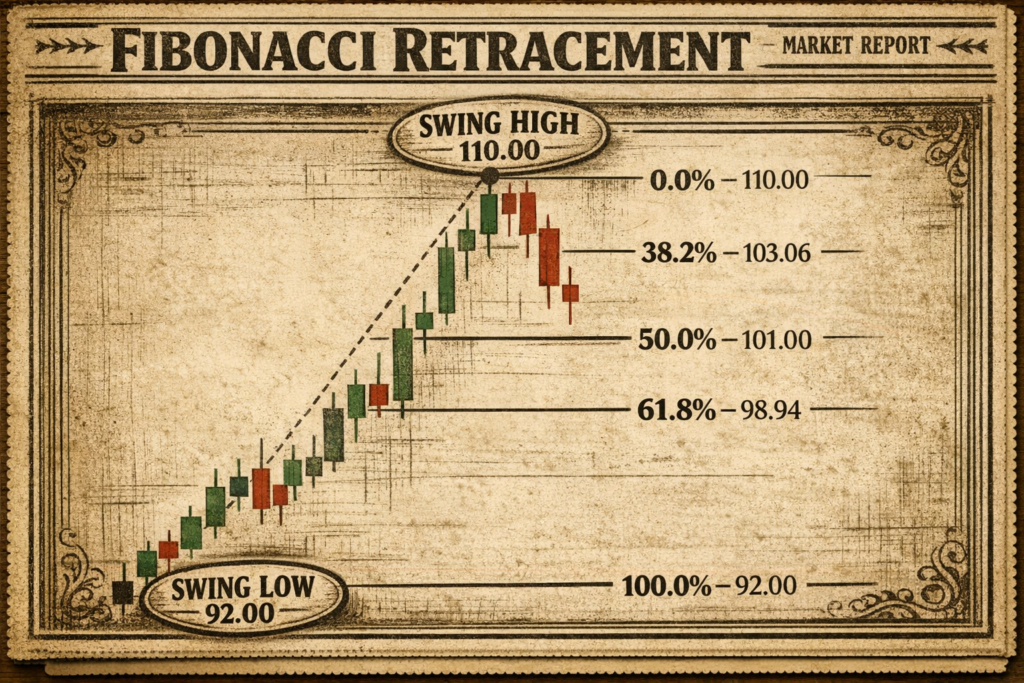
Classic Fibonacci Retracement — The Trap Zone
Running that theory through a computer shows the opposite:
Buying inside those retracement levels results in a tiny 5.17% annual return since 1993.
Like poison for your portfolio.
Meanwhile, buying outside those levels and then selling when price goes inside them showed a 25% annual return and 100% winning years.
In other words, consistency comes from doing the opposite of this extremely popular technique.
I’ll prove it right now. Here’s a backtest using classic Fibonacci retracements, and then doing the opposite:
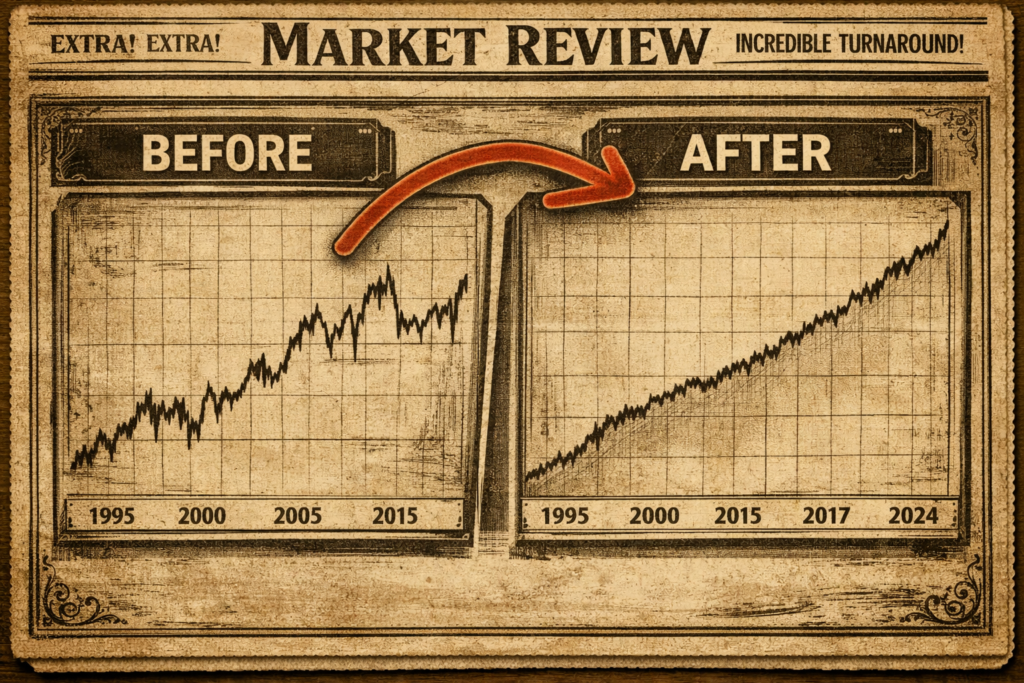
Backtest Comparison: Classic Fibonacci vs. The Anti-Fibonacci Method
The bear market of 2000–2002? Erased.
Great Recession of 2008? Barely a hiccup.
Which returns would you rather earn?
Think about that.
What if the “smart” entry isn’t so smart?
What if the “safe” pullback is exactly what makes traders late?
What if the most widely taught chart logic is quietly pushing people away from the very stocks with the biggest upside?
That’s the idea behind The Anti-Fibonacci Method.
A data-driven trading approach built on what actually worked from 1993–2026…
- Not what sounds good on a webinar.
- Not what looks pretty on a chart.
- Not what some guru has been repeating for 20 years.
This method came from one place only: The evidence.
And the evidence said something startling: In many cases, the market’s best stocks didn’t reward hesitation. They rewarded strength. They rewarded leadership. And they often moved higher from price zones most traders have been taught to distrust.
Because sometimes the straightest path to better trading results begins by unlearning what the crowd thinks is “obvious.”
So What Exactly Is The Anti-Fibonacci Method?
It starts with a simple observation. Most traders are taught to buy the pullback. More specifically, they are taught to buy one of a handful of familiar retracement levels that have been repeated in books, courses, webinars, and YouTube videos for decades:
38.2% 50% 61.8% 78.6%
The Classic Retracement Trap Zone
Those numbers have become almost sacred in retail trading.
Traders stare at them.
Wait for them.
Plan around them.
And pile in as if the market is somehow obligated to respect them.
But when we reverse-engineered 33 years of market history and studied 5,005 trades… we found something the gurus almost never tell you:
Those popular retracement levels can become a crowded danger zone.
A place where eager buyers step in too early…
A place where weak hands cluster together…
And a place where predictable stops can pile up just below the exact levels everyone is watching.
In other words… what most traders think of as the “smart” place to buy can become the exact place they get trapped.
That is why we call it The Anti-Fibonacci Method. Because instead of treating those classic retracement levels as a green light… this method treats them as a kind of No-Go Zone.
Not a welcome mat. A warning sign.
Be careful around 38.2%, 50%, 61.8%, and 78.6%. Because those are the levels where textbook traders often crowd in… only to get flushed out when the stock pushes just a little deeper than they expected.
And that flush matters. Because once those predictable buyers are trapped… once the weak hands are shaken out… once the stops beneath those levels start getting hit… something very different can happen.
The stock can move into a zone where the emotional, obvious, crowded buying is already out of the way.
That is where this method begins to look for opportunity.
Not in the middle of the textbook retracement… but below it.
Below where the books say to buy. Below where the chart-course students feel “safe.” Below where many Fibonacci traders have already been stopped out.
That is the mechanism. Not chasing. Not random dip buying. Not blindly fading weakness. It is a very specific idea:
Avoid the crowded Fibonacci buy zone… and look for opportunity where the crowd has already been punished.
That is a radically different mindset than what most traders are taught. Most traders want confirmation from a familiar level. This method assumes familiarity can be dangerous.
It does not ask: “Where do traders hope the stock will bounce?”
It asks: “Where did the data show the better opportunity actually began?”
And the answer, again and again, was deeply inconvenient for traditional chart education: Not inside the classic retracement zone. Often after it. Often below it.
That is the essence of The Anti-Fibonacci Method. A strategy built not around worshipping famous retracement levels… but around recognizing them for what they often become: A No-Go Zone.
33 Years. 5,005 Trades. Supercomputer-Discovered.
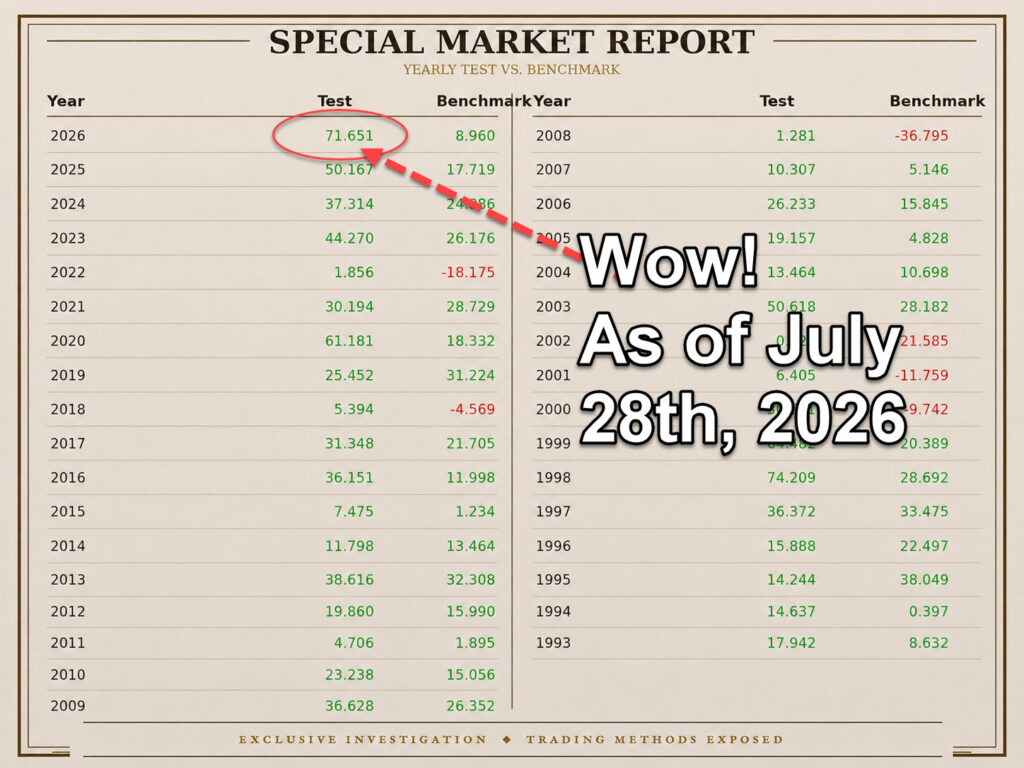
Of course, none of this matters if it only sounds good on paper. That’s why The Anti-Fibonacci Method was not built from a few cherry-picked chart examples… or a guru’s opinion… or a lucky stretch of market history.
It was discovered by a supercomputer that reverse-engineered 33 years of market data, covering 1993 through 2026, and produced 5,005 trades.
That means this was tested through bull markets, bear markets, crashes, recoveries, and everything in between.
But here’s the part most trading gurus leave out… We did not let the machine optimize on all the data and then pretend the result was “proven.”
To help avoid overfitting, we deliberately held back 20% of the data so the strategy had to prove itself on unseen market history it had never been trained on before.
And we took it one step further. We also looked at an additional out-of-sample year afterward — almost like setting the strategy on a shelf, walking away, and then coming back a year later to see how it actually performed.
That matters. Because anybody can make a strategy look smart when they keep peeking at the answers. The real test is whether it can hold up when the future arrives.
Not theory. Not fluff. Not chart-book mythology.
Just a hard, uncomfortable question asked over and over by a machine that did not care what the gurus believed: What actually worked?
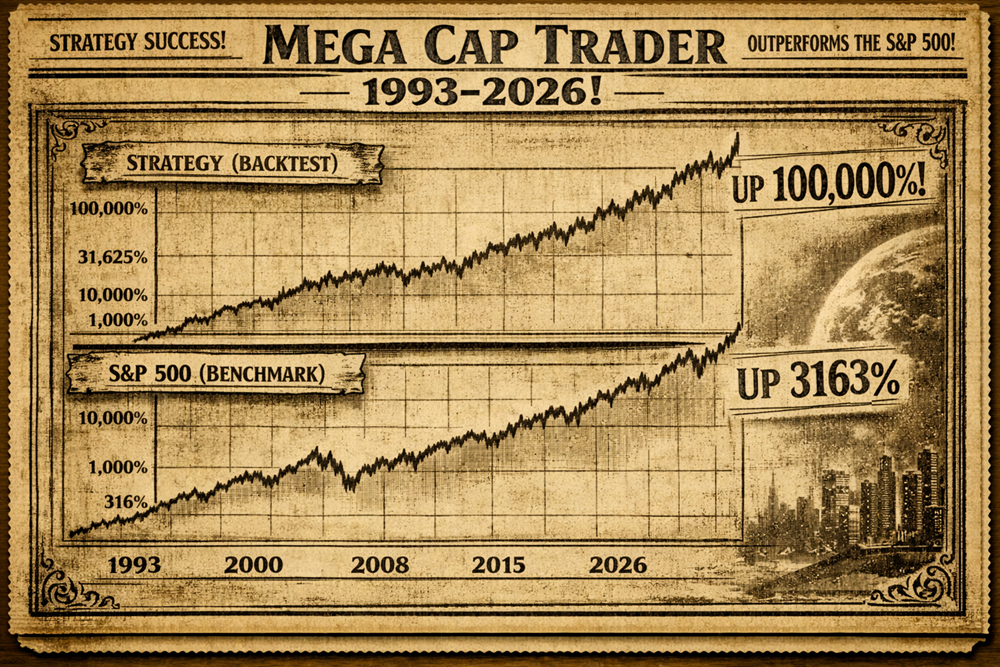
Strategy (Backtest) vs. S&P 500 Benchmark — 1993 through 2026
And the answer it kept coming back with was clear: The famous Fibonacci retracement levels were often not the opportunity… They were the trap.
The Gurus Have Been Teaching Traders Backward Logic
This bad advice didn’t show up last week. It goes back a long way.
Samuel A. Nelson’s The ABC of Stock Speculation, published in 1902, was already discussing reactions of roughly one-half and sometimes about two-thirds of a move as normal buying territory.
Then Ralph Nelson Elliott formalized his wave work in 1938 and promoted it further in 1939, helping turn retracement thinking into a permanent part of market lore.
So for more than a century, traders have been taught some version of the same basic idea:
Wait for the pullback.
Buy the retracement.
Trust the level.
Don’t chase strength.
Sounds prudent. Sounds patient. Sounds smart. And that is exactly why it has been so effective at misleading people.
Because once enough traders are staring at the same retracement zones… once they are all leaning on the same “safe” entry logic… those levels stop being clever. They become crowded. They become obvious. They become a trap.
That is the part the gurus skip. They present retracement levels as opportunity. But in the real world, crowded textbook levels often become the place where traders pile in too early… put their stops in predictable places… and get knocked out together.
That is backward logic. It trains traders to buy where the crowd feels comfortable, not where the evidence is strongest.
And if the logic is wrong, then following it with more discipline does not solve the problem. It just gets you to the wrong destination faster. That is why Mega Cap Trader starts with a very different premise: The crowd’s favorite retracement zone may be the worst place to buy.
My Search For What Actually Works
If we haven’t met yet… I’m Dan Murphy, founder of Portfolio Boss.
And long before my company existed, I did exactly what most trading gurus tell people to do.
I followed the news… and got whipsawed. I covered my charts with Elliott Waves and Fibonacci lines that looked elegant… right up until they helped empty my account.
I tried the indicator mash-ups, too. MACD. RSI. Bollinger Bands. Trend lines. If it flashed on a screen and somebody claimed it could predict the market, I probably tried to trade it.
And I blew out three trading accounts proving, the hard way, that popular trading advice and profitable trading are not the same thing.
After the third meltdown, I made myself a promise:
“Never place another trade I couldn’t test with a computer first.”
That one decision changed everything.
Since 1997, I’ve traded rules-based systems through bull markets, bear markets, crashes, recoveries, and those miserable sideways periods that chew up “genius traders” and spit them out. And I’m defensive by nature. I don’t care about exciting. I care about surviving… compounding… and using methods that can still function when the market stops cooperating.
Because retirement money does not need a legend. It needs a process. A process with evidence behind it.
Author of 4 trading books including The Relaxed Investor
Ran the Million Dollar Target project — real money, real trades, nowhere to hide
Returns independently audited by a CPA before rolling profits back into research
Invested $6.2 million building Portfolio Boss and its machine-learning research engine
Trading rules-based systems since 1997
“We do not ‘feel’ our way into trades. We prove our way in.”
— Dan Murphy, Founder, Portfolio Boss
That is the journey that led me here. And it is exactly why, when the machine started exposing the weakness in those famous retracement zones… I paid attention.
Why Mega Caps?… And The “Trigger Day” That Must Occur Before We Place A Trade
Once the pattern was clear, the next question was obvious: Where should this idea be applied?
Not in thin, jumpy little stocks. Not in illiquid names that look great in a backtest and trade terribly in the real world. Not in obscure situations where one bad fill can wreck the whole premise.
Mega caps.
The biggest, most liquid, most institutionally followed names in the market.
The stocks with enough volume, enough sponsorship, and enough real-world tradability to make disciplined execution possible. That matters. Because if you are going to build a serious strategy, you want serious raw material.
Now here is where Mega Cap Trader becomes even more selective. Because we do not just trade any mega cap stock that wanders into the setup. Before a stock can even qualify…
It must have experienced what I call a Trigger Day within the past 12 months.
No Trigger Day? No trade. Period.
I keep the exact discovery close to the vest for a reason. Because this one filter turned out to be enormously important. It dramatically smooths the return profile. And it cuts drawdowns roughly in half.
Think about what that means. This is not just about finding an entry. It is about restricting the strategy to the kinds of stocks that have already demonstrated a very specific kind of behavior in the recent past. That one condition acts like a gatekeeper.
Most traders are constantly asking: “Can I find a reason to take this trade?”
Mega Cap Trader asks: “Has this stock earned the right to even be on the list?”
That is a very different mindset. Now, once a stock passes the Trigger Day filter, the method still does not rush in blindly. It avoids the classic Fibonacci retracement trap zone: 38.2%, 50%, 61.8%, and 78.6%.
So the method waits for opportunity below that zone. Below where the books say to buy. Below where the textbook traders often get shaken out.
And when it is time to enter… it uses a limit order. That matters because a limit order imposes discipline. It lets the strategy name its price. It helps buy a controlled dip rather than chase emotionally.
And once in? The strategy uses a relatively close soft exit. Because a weak trade should not be allowed to linger and grow fangs.
Step 1: Mega cap stocks only.
Step 2: Only if a Trigger Day occurred in the last 12 months.
Step 3: Avoid the Fibonacci No-Go Zone (38.2%, 50%, 61.8%, 78.6%).
Step 4: Enter with a disciplined limit order.
Step 5: Exit with a soft stop if the trade weakens.
Simple enough to follow. Selective enough to matter. And powerful enough to produce a much smoother ride than most traders are used to seeing.
About 10 Orders A Week… Without Turning Trading Into Another Job
One of the biggest lies in trading is that more complexity means more edge. More screens. More indicators. More alerts. More decisions. More time chained to the market.
As if the path to better results is to turn yourself into a full-time babysitter for every wiggle on a chart. That may appeal to people who want trading to feel important… but it is a terrible way to live. And for most people, it is a terrible way to trade.
Mega Cap Trader was built to avoid that trap. This is not some hyperactive day-trading circus firing off dozens of decisions every afternoon. It averages about 10 orders per week.
That is enough activity to matter… but not so much that your life starts revolving around every tick, headline, and hiccup in the market.
A strategy is not just judged by how it performs in a spreadsheet. It is judged by whether a real human being can actually live with it.
You are not being asked to scan thousands of charts. You are not being asked to sit in front of six monitors all day. You are not being asked to decode market astrology every morning before breakfast.
And here is the best part: This strategy can be 100% automated.
Which means you do not have to sit there manually entering every order like some kind of overcaffeinated air traffic controller. You do not have to wonder whether you clicked the right thing. You do not have to let emotion sneak in at the last second and ruin a perfectly good setup.
A smarter way to trade… without turning yourself into the employee of your own brokerage account.
Here’s What You Get Today
By now, you understand the problem… You understand the trap… And you understand the machine-discovered logic behind The Anti-Fibonacci Method. So let’s make this simple.
Mega Cap Trader Strategy
The complete rules-based approach for trading mega cap stocks using the Anti-Fibonacci framework. Built around the No-Go Zone, the Trigger Day filter, disciplined limit-order entries, and soft exits designed to keep weakness from turning into unnecessary damage. This is the actual edge — reverse-engineered from 33 years of market history and 5,005 trades.
Portfolio Boss Evo
You are not just getting a strategy concept floating around in a PDF. You are getting the software needed to actually run the strategies. To test them. To manage them. To use them in the real world. And this is a lifetime offer. No monthly software fee. No ongoing license fee. No “gotcha” charge six months from now. You get Mega Cap Trader. You get Portfolio Boss Evo. And you get it with no other fees.
Agent Alpha
Even a good strategy can be ruined by human behavior. People hesitate. They get busy. They second-guess. They override the signal. They miss entries. They botch exits. They turn a disciplined method into emotional mush.
That is why you also get Agent Alpha. This is world-class auto-trading built to help execute the strategy automatically. Not toy automation. Not some flimsy little add-on. Real automation built for serious traders — including multi-account capability.
Fewer missed trades. Less hesitation. Less interference. Less opportunity for human emotion to leak into a proven method and dilute the edge. It helps keep the strategy true to itself.
The “I ❤ Evidence-based Trading” Mug

This is not just some throwaway trinket tossed in to pad the offer. It means something.
Because there are two kinds of traders in this world. The first kind chases stories. Chases gurus. Chases hype. The second kind wants proof. Wants testing. Wants data. Wants to know what actually held up when real market history had the final vote.
That second group is your group now. This mug is a small but visible reminder of that identity. You are not here to guess. You are not here to hope. You are not here to trade on folklore. You are here to follow evidence.



Who Mega Cap Trader Is For… And Who It Isn’t
Let’s be clear. Mega Cap Trader is not for everybody. And that is a good thing.
Mega Cap Trader IS For You If…
- You want a method that is rules-based and evidence-based
- Built on 33 years of testing, focused on mega cap stocks
- Structured to be simple enough to follow and powerful enough to be 100% automated
- You want about 10 orders a week — not a second job
- You’d rather trust data than dogma
- You’re tired of guru opinions, endless second-guessing, and trading on hope
This Is NOT For You If…
- You need the thrill of constant action
- You want to override the system every time the market twitches
- You love guru predictions more than hard evidence
- You want dozens of indicators and the illusion of control
- You believe a strategy should be judged by how exciting it feels
Mega Cap Trader is not built to entertain you. It is built to give you a tested, disciplined way to trade the market’s biggest stocks. So if you want excitement… there are plenty of chat rooms, penny stocks, and “can’t-miss” gurus for that. But if you want a calmer, smarter, more evidence-based way to trade… then you are exactly the kind of person this was made for.

Why Now?
Because every month you keep trading with backward logic carries a cost. Not just in money. In missed opportunities. In avoidable drawdowns. In frustration. In time spent following ideas that may have sounded smart for years… but never earned the right through real testing.
And that cost compounds. The market does not hand out refunds for bad assumptions. It does not give you credit for effort. If the logic is wrong… time does not fix it. It usually makes the damage worse.
“Later” is an expensive word in trading.
At some point, the smart move is not to keep gathering more opinions. It is to switch to a tested process. That is the opportunity in front of you now. Not just to buy a strategy… but to stop trading like the crowd. To stop leaning on the same famous levels everyone else is leaning on.
And the sooner you put automation to work… the sooner you can stop letting hesitation, distraction, and emotion interfere with a strategy that already knows what it is supposed to do.
Ready to Stop Trading Backwards?
Get Mega Cap Trader, Portfolio Boss Evo, Agent Alpha,
and join the evidence-based side of trading once and for all.
Call Adam and get the details. See if Mega Cap Trader is the right fit for you. Call Adam and take the next step toward a simpler, more evidence-based, more automated way to trade the market’s biggest stocks.
516-220-8221
Dan Murphy
P.S. If you’re tired of guru opinions… tired of crowded chart-book logic… and tired of wondering whether the “safe” entry is actually the reason you keep missing the best moves… then maybe it’s time to look at trading from the evidence-based side. Mega Cap Trader gives you a machine-discovered strategy built on 33 years of market history, 5,005 trades, and a simple principle most traders have never been taught: The famous Fibonacci retracement levels are often not the opportunity… They’re the trap. And with Portfolio Boss Evo included, Agent Alpha available to automate the process, and no ongoing fees, this is built to be a practical way to trade the market’s biggest stocks without turning trading into another job. To get the details, call Adam at 516-220-8221.
P.P.S. You can keep doing what most traders do… waiting for the pullback, trusting the textbook levels, and hoping this time the crowd is right… Or you can step into a different camp. The camp that wants proof before risk. The camp that believes markets should be tested — not romanticized. The camp that knows real edges are usually found where the crowd is not looking. Call 516-220-8221 and ask Adam about Mega Cap Trader.
P.P.P.S. And yes… your “I ❤ Evidence-based Trading” mug comes with it. Because at some point, trading stops being about collecting opinions… and starts becoming about who you are.
What Are People Saying?

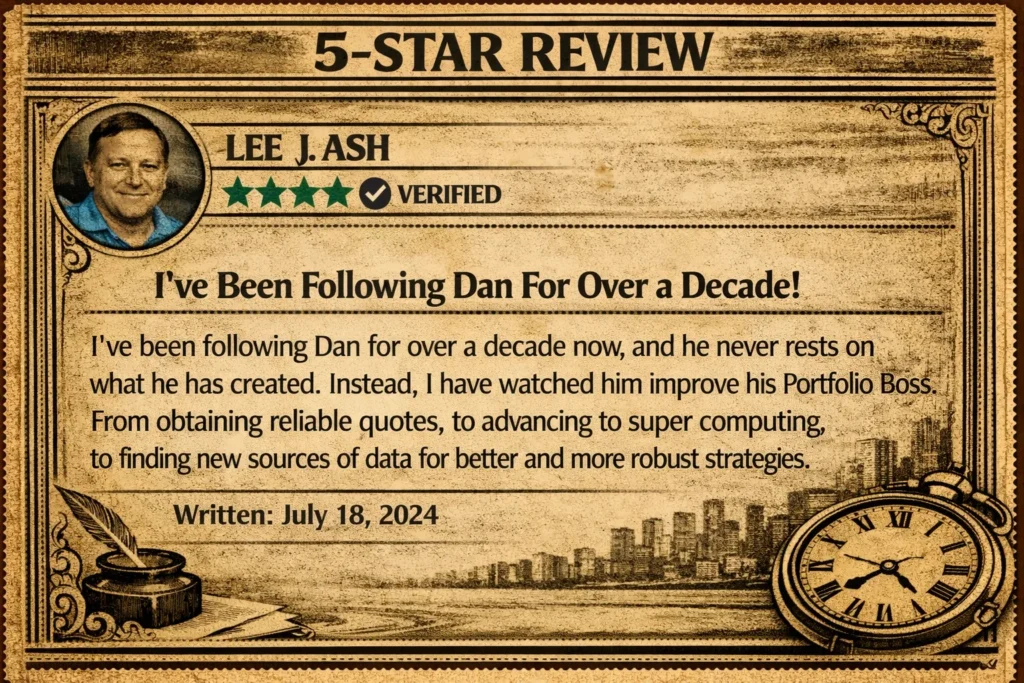
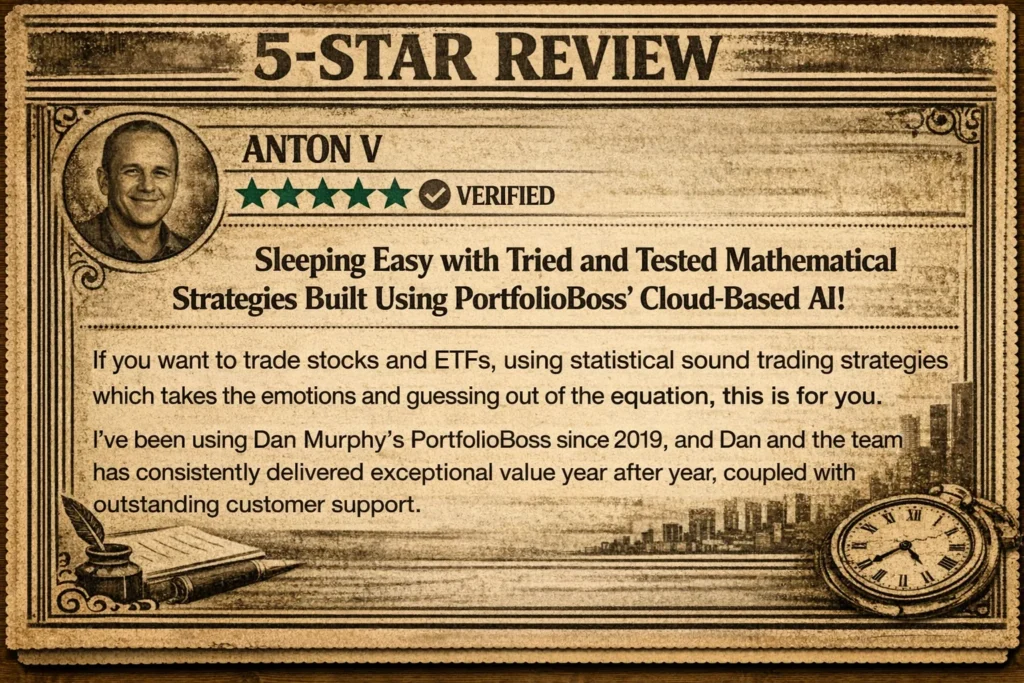
Member Reviews 4.8/5 Stars ★★★★★
“Now we understand what puts the “fib” in Fibonacci. It’s always fascinating to see traditional trading methods challenged. The strength of this strategy lies in its simplicity and reliability. Although generating profits in a bear market can be nearly impossible, this method has shown consistent profitability for 33 consecutive years.”
Trade more smarter, lol,
Jason
I’ve been following Dan and his team for 12 years now, since the inception of Portfolio Boss, and albeit I did not have the bank account to invest real money way back then, I can tell you that my bank account has now turned into a portfolio of significant value thanks to Dan’s teachings. I have never followed any trader for as long as I have followed Dan; not because he has promised delivery….because he has delivered! Over the years I have flushed all other trading gurus and talking heads to follow Dan’s teachings, and I have not been let down! The latest of his long line of significant proofs has been to debunk Fibonacci Retracements with the Mega Cap Anti-Fibonacci strategy.Most trading ‘gurus’ sell perfection; Dan sells reality. This strategy caught my eye because it does the exact opposite of what traditional TA teaches. It’s a ‘red pill’ for chart logic—instead of hunting for magical bounce points, it identifies where the crowd gets trapped and waits for the trap to spring.The robustness is what sold me. This wasn’t just a computer-generated fluke; it underwent seven years of out-of-sample testing and a year of live monitoring.
I was skeptical about ‘fading’ Fibonacci—unlearning the ‘golden ratio’ is no small feat—but the evidence is undeniable. It’s the same innovation I saw with their MACD reversal years ago. If you’re a rules-based trader tired of being ‘liquidity’ for institutional stop-runs, this is the defensive, automated mindset you’ve been looking for. Stop trading on ‘feel’ and start trading on proof.
Hope this helps,
Eric J. Avon
“The Mega Cap trading strategy is brilliant! It mimics no trading logic I’ve seen before and It’s easy to trade.”
Russ Lang
“I was becoming discouraged with all the BS in the trading world out
there. Each time I thought that I found a winning system (because it
sounded good and somewhat made sense or was hyped by a known guru),
it never lived up to the hype and I would either lose money or
barely break even. Portfolio Boss is different and that’s why it
restored by faith in trading. It uses verified data to confirm that
a trading system works and the contrarian in me could finally test.
The Mega Cap strategy is further confirmation that a lot of what is
taught “sounds great” but simply doesn’t work in the real world.
Portfolio Boss gives traders of all account sizes a fighting chance
and actually an edge, because we can validate before trading, and
that makes all the difference. In fact, I’m using Portfolio Boss to
test and validate the Mega Cap strategy in my portfolio to see how
it will increase my returns and should be in added by the end of
this week.”
Serge Lalonde
The anti-Fibonacci. Another example from Dan to relentlessly innovate, investigate, study, analyze, and find the next breakthrough. The markets are so dynamic and evolving, your strategies must do the same. I was impressed with the strategy as PB program allows you to see everything , no hidden tricks, no hidden code. I personally feel a bit better investing in companies that I know. That is why I like stocks with Data. I am so past chasing the hot small stocks, ipo’s, etc that have so much variability. As a retired professional, I appreciate the focus on minimizing down months. While I am not an income investor at this point, positive returns are a great peace of mind.
Go data, go testing, and go PB!
Sincerely Mark Jones
Q: What exactly is Mega Cap Trader?
Mega Cap Trader is a rules-based strategy for trading the market’s biggest stocks using The Anti-Fibonacci Method. Built from machine-driven research across 33 years of market history and 5,005 trades to identify what actually worked — not what gurus merely claim should work.
Q: What makes this different from ordinary chart-based trading?
Most chart-based trading teaches people to buy popular retracement zones like 38.2%, 50%, 61.8%, and 78.6%. Mega Cap Trader treats those levels very differently — as a No-Go Zone where textbook traders often pile in and get trapped.
Q: Does this mean I’ll be chasing stocks higher?
No. Mega Cap Trader uses limit orders for entry, so the strategy can buy on a controlled dip rather than lunge after price emotionally.
Q: How often does it trade?
On average, the strategy generates about 10 orders per week — enough activity to matter without becoming a hyperactive trading circus that takes over your life.
Q: What is a “Trigger Day”?
A stock must have experienced a specific event we call a Trigger Day within the last 12 months or we do not trade it. This filter dramatically smooths returns and cuts drawdowns roughly in half.
Q: Is this fully automated?
It can be. That is where Agent Alpha comes in — world-class auto-trading designed to automate execution, including multi-account handling, so you can follow the strategy without turning trading into another job.
Q: Are there monthly fees or hidden charges?
No. This is a lifetime offer. No monthly software fee. No ongoing license fee. No surprise recurring charge. Ever.
Q: What’s the next step?
Call Adam at 516-220-8221 and get the details on Mega Cap Trader, Portfolio Boss Evo, Agent Alpha, and the lifetime offer.
Portfolio Boss ◆ Mega Cap Trader ◆ Evidence-Based Trading Since 1997
© 2026 Copyright All Rights Reserved. Portfolio Boss, Inc.
Government required disclaimer: The results listed herein are based on hypothetical trades. Plainly speaking, these trades were not actually executed. Hypothetical or simulated performance results have certain inherent limitations. Unlike an actual performance record, simulated results do not represent actual trading. Also, since the trades have not actually been executed, the results may have under (or over) compensated for the impact, if any, of certain market factors such as lack of liquidity. You may have done better or worse than the results portrayed.